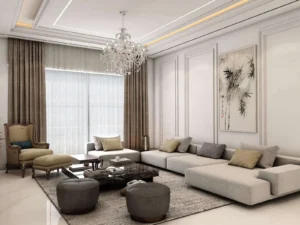
The 7 principles of interior design are unity balance, scale and ratio, flow, focus, contrast (variety) and functionality. They’re the rules designers use to arrange furniture, color, light and decor so a room looks good and works well.
If you are decorating a small apartment or designing a whole house in Lahore, these basics will help you make confident choices. We dissect each principle below with a practical tip, then show you how to find your own design style and turn it into a plan.
Why Interior Design Matters?
The places we live and work impact how we feel and how we perform. Light, color, noise, layout and clutter can all affect mood, stress levels and concentration. A well designed interior will make you feel more relaxed at home, more productive at work and more comfortable in your daily life.
Interior design is personal also. From family rooms filled with heirloom furniture to a clean, minimalist home office, your home is an extension of your values and taste. A well designed space is beautiful and feels like home.

What Are the 7 Principles of Interior Design?
At the heart of every well-designed interior lies a set of fundamental principles. These principles serve as the guiding framework for creating spaces that are not only visually appealing but also functional and harmonious. Let’s delve into each principle and explore its significance in shaping our living environments:
1. Unity/Harmony
Unity means the design elements in a room belong together. Repeating colors, materials, and shapes creates a sense of cohesion, so the room feels planned rather than random. choose one dominant style and a limited color palette, and repeat them throughout the room.
2. Balance
Balance is the equal distribution of visual weight in a room. There are basically two types:
- Symmetrical balance mirrors elements on either side of a central point, such as matching nightstands and lamps on either side of a bed. It has a formal and stable feel.
- Asymmetrical balance, dissimilar items that have similar visual weight, such as a large sofa with two armchairs and a plant. It feels relaxed and alive”
Don’t put all the heavy furniture on one side of the room.
3. Scale/Proportion
Scale is the relationship of the size of an object to the room and to other objects. Proportion is the relation of parts to each other and to the whole, the height of a lamp to the table beneath, for example.
When scale and proportion are right, nothing feels too big or too small A too-large sofa can dominate a small room, while a too-small rug can make a large room feel unfinished.
Before you buy, measure your room and furniture, and make sure you get a rug large enough to sit under at least the front legs of your sofa and chairs.
4. Rhythm/Repetition
Rhythm makes movement and leads the eye through the room. This is from repeating colors, shapes or pattern, or by gradually changing them, like cushions that go from light to dark tones.
Repeat an accent color three times or more in a room, in different spots and sizes.
5. Emphasis/Focal Point
Every room needs a focal point, the feature that draws the eye first. It might be a fireplace, a large artwork, a statement light, or a beautiful window view. Other elements should support it rather than compete. Arrange seating to face the focal point and keep the area around it simple.
6. Contrast/Variety
Contrast is what gives a room interest and stops it from looking flat. You can create it in light and dark, smooth and rough, or curved and straight lines. Variety adds personality, but it is most effective when balanced with unity.
If a room is largely neutral, add contrast with texture, such as a chunky knit throw or a woven basket.
7. Functionality
A failed room is a beautiful room that doesn’t work for the people who use it. Function means comfortable seating, plenty of storage, good task lighting and ease of flow through the space. plan the layout around how you actually use the room, then choose the style.
How to Find Your Interior Design Style?
There are many interior design styles. These are some of the most popular:
- Minimalist: follows “less is more” with clean lines, open space, and a neutral palette. Every item has a purpose.
- Bohemian: free-spirited and eclectic, with vibrant colors, layered textures, and a mix of cultural influences.
- Contemporary: sleek, current, and sophisticated, with clean lines, geometric shapes, and modern materials.
- Traditional: classic and refined, with ornate furniture, rich colors, and detailed finishes.
- Scandinavian: light, airy, and cozy, with white and soft neutral tones, natural wood, and simple furniture.
- Industrial: raw and urban, with exposed brick or concrete, metal fixtures, and a darker palette.
Not sure which one suits you? A professional interior designer in Lahore can help you choose a style that fits your home and lifestyle.
Identifying Personal Preferences
The first step to finding the style that suits you is to understand how you live and what you like.
- Consider your lifestyle. Think about how you use space. Do you enjoy entertaining friends and family? Or do you prefer quiet evenings at home?
- Get inspiration Check out magazines, websites, and social media. Notice the colors, textures and patterns you keep coming back to and save those images.
- Know your comfort zone Do you like bold, statement-making designs, or would you rather have a calm, understated look? This can help you narrow your selections.
Translating Preferences into Design
Once you know what you like, turn it into a plan:
- Choose one main style and one or two supporting styles. Mixing styles is fine as long as one leads.
- Pick a color palette. The 60-30-10 rule (60% main color, 30% secondary, 10% accent) is a reliable guide.
- Start with one room, apply the principles above, and build from there.
- Test before you commit. Use paint samples, fabric swatches, and a simple floor plan.
Conclusion
The 7 principles of interior design, unity, balance, scale and proportion, rhythm, emphasis, contrast, and functionality, give you a reliable framework for any room. Use them together, start with your own style and lifestyle, and let the room reflect who you are.
If you would like help applying these principles in your home, contact Archi Cubes for a free interior design consultation in Lahore.
FAQs
What is the difference between the elements and the principles of interior design?
Elements are the building blocks, such as color, texture, line, and light. Principles are the guidelines for arranging those elements well.
What is the most important principle of interior design?
Many designers say functionality comes first, because a room must work for the people who use it. Unity and balance then make it feel complete.
What is the difference between symmetrical and asymmetrical balance?
Symmetrical balance mirrors elements on both sides of a central point. Asymmetrical balance uses different items of similar visual weight to achieve balance without mirroring.
How do I find my interior design style?
Look at how you live, gather pictures you like, and notice the colors and textures you return to. Then match them to a style such as minimalist, contemporary, traditional, or bohemian, and mix elements to make it your own.